
How much are you prepared to pay from your own pocket before your insurer contributes a single franc? In Switzerland, that figure is your franchise, and it quietly shapes every monthly premium under the mandatory basic scheme. Before you commit, it is worth taking the time to compare Swiss health insurance plans and deductible impacts across providers.
Selecting the right health insurance deductible is one of the few levers you personally control each year. The franchise ranges from CHF 300 to CHF 2,500 for adults, in fixed steps. A higher amount reduces your premium, yet it raises your financial exposure when illness or an accident strikes.
What a Swiss health insurance deductible really means
The franchise is the fixed annual amount you pay yourself before basic insurance (OKP/LAMal) reimburses anything. Adults may choose CHF 300, 500, 1,000, 1,500, 2,000 or 2,500. Children can be set between CHF 0 and CHF 600, in steps of 100.
Once the franchise is exhausted, a second layer applies. You then pay a 10 percent coinsurance, called the Selbstbehalt, capped at CHF 700 per year for adults and CHF 350 for children. This is precisely why learning how to choose health insurance deductible levels matters so much for your annual budget.
How your deductible shapes your monthly premium
The underlying logic is straightforward. A higher franchise lowers your premium, because you agree to absorb more risk yourself. The federally regulated monthly discounts against the CHF 300 baseline are uniform nationwide: roughly CHF 14 less for the CHF 500 tier, and about CHF 147 less for the CHF 2,500 tier.
Premium pressure, meanwhile, is not a new phenomenon. In 2024, average premiums rose by 8.7 percent, followed by a further 6 percent in 2025, according to Swiss federal figures. Understanding this backdrop helps; for the wider context you may consult our guide to health insurance essentials in Switzerland.
The 2026 premium landscape across Switzerland

In 2026, the average monthly premium across the country reached CHF 393.30, a 4.4 percent increase, as confirmed by the Federal Office of Public Health. For adults specifically, the average premium climbed to CHF 465.30 per month.
Regional differences remain considerable, which strengthens the case for annual review. A Deloitte survey noted that the cheapest adult premium actually rose by 7.1 percent, and it expects between 7 and 10 percent of policyholders to switch provider, according to SWI swissinfo.ch. Your deductible choice sits inside this shifting national picture.
High or low deductible: matching the choice to your life
Consider three common profiles. If you are generally healthy, with no recurring treatment, the CHF 2,500 maximum usually pays off, because the premium saving comfortably exceeds your expected costs in a typical year.
If you are pregnant, managing a chronic condition, or facing planned surgery or scheduled dental work, the CHF 300 minimum almost always wins. You will reach the franchise regardless, so it is logical to keep the threshold low. For those in their mid-thirties with only occasional visits, the CHF 1,500 tier is an often underrated middle ground.
Finding your personal break-even point
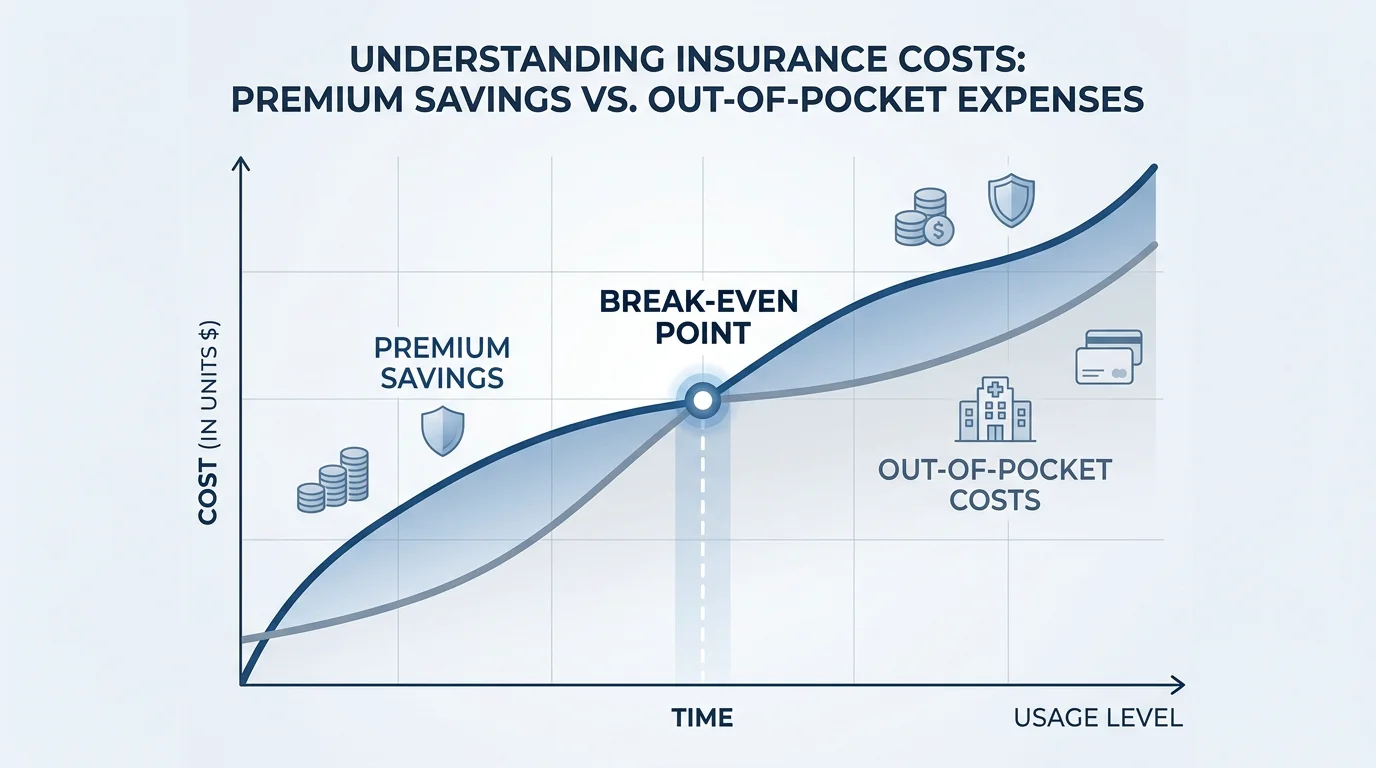
The break-even point is the annual medical spend at which a higher franchise stops saving you money. For the CHF 300 deductible, it becomes the financially sensible choice once you expect at least CHF 1,800 to CHF 1,900 in eligible costs, according to moneyland.ch.
The calculation is worth doing carefully. For each tier, compare the annual premium discount against the CHF 300 baseline with the extra franchise plus the 10 percent coinsurance, up to the CHF 700 cap. Where the saving equals the extra exposure, you have found your break-even. Below that spend, the high tier nets positive; above it, the low tier wins.
Families, children and pre-existing conditions
Households rarely fit a single profile. Young children often need regular checkups and vaccinations, so a lower franchise for them frequently reduces total family costs. Because each insured person chooses independently, you can mix a high adult franchise with a low one for a child.
Health history matters too. If you already know that treatment is likely, understanding how pre-existing conditions affect deductible/out-of-pocket planning can prevent an expensive mismatch. When weighing individual insurers, our review of CSS health insurance: coverage, costs and deductible considerations illustrates how coverage and franchise interact in practice.
Making a confident deductible decision
Ultimately, knowing how to select the right health insurance deductible comes down to honest forecasting. Estimate your expected annual medical spend, compare it against the break-even point for each franchise tier, and factor in your tolerance for a large one-off bill. Healthy, low-usage years reward a high franchise; predictable, high-cost years reward the minimum. Review your choice every autumn, because premiums, health and household circumstances all change from one year to the next.
Take action with Mathias Sudres
Working out your personal break-even point, comparing insurers and coordinating franchise levels across a whole family can quickly become complex. If you would prefer clarity over guesswork, independent guidance helps you weigh premiums, out-of-pocket exposure and coverage in one structured conversation.
As an independent, FINMA-registered insurance and pension advisor, we compare the Swiss market with full transparency, no tied products and no hidden commissions. We begin with a free initial chat to understand your situation, explain your options in plain language, and remain available afterwards. Contact us to review your deductible and wider coverage with confidence.
Frequently Asked Questions
What is the minimum and maximum deductible for adults in Switzerland?
Under the mandatory basic scheme, adults choose an annual franchise between CHF 300 and CHF 2,500. The intermediate options are CHF 500, 1,000, 1,500 and 2,000. Children may be set from CHF 0 up to CHF 600.
Does a higher deductible always save money?
No. A higher franchise lowers your premium, but it only pays off if your actual medical costs stay below your break-even point. If you require frequent care, the premium saving is usually erased by higher out-of-pocket spending.
When can I change my deductible?
Franchise changes generally take effect on 1 January, with notification required by 30 November. Most households therefore adjust during the autumn cycle. Certain events, such as starting self-employment or leaving Switzerland, can trigger off-cycle changes.
How does the coinsurance work after the deductible?
Once your franchise is exhausted, you pay 10 percent of further costs as coinsurance. This is capped at CHF 700 per year for adults and CHF 350 for children. Above the cap, basic insurance covers the remaining costs in full.
Can an advisor help me pick the right deductible?
Yes. As an independent, FINMA-registered advisor, we compare the whole Swiss market and calculate your break-even point objectively. We then explain the trade-offs clearly so that you can decide with full understanding of premiums and exposure.