What if two people with identical Swiss pension balances kept very different amounts of money simply because of where their pension foundation was registered? That is not a hypothetical. It is the single most overlooked reality of pension planning at emigration, and it is settled by paperwork you signed years earlier rather than by anything about your career or your salary. Understanding how pension withdrawals work when you leave Switzerland is a genuine financial decision, not an administrative formality. A sensible starting point is our guide to the best third pillar providers for withdrawals.
Switzerland operates a three-pillar system, and each pillar behaves differently the moment you deregister. The state pension follows one set of rules, the occupational second pillar another, and the private third pillar a third. Your destination country then adds a layer of tax treatment on top. The good news is that the levers are known, finite, and available to anyone who plans early.
What happens to each pillar when you leave Switzerland
A practical leaving Switzerland pension withdrawal guide begins with one distinction: which pillar holds your money, and where you are moving. Your first pillar (AHV/AVS state pension) contributions generally cannot be refunded if you relocate to a country with a Swiss social security agreement; instead they translate into a future retirement entitlement. Refunds are only possible when you move to a country without such an agreement, subject to strict conditions.
The second pillar (BVG occupational pension) and Pillar 3a are where the real decisions sit. Both belong to you, and both can normally be released once you have left the country permanently and deregistered with your commune. Pillar 3a is otherwise locked until retirement, and permanent emigration is one of the few legal grounds for early release. If you are still weighing where to hold that account, our explainer on how to choose the best third pillar in Switzerland sets out the criteria that matter before departure.
The canton-of-foundation lever most people miss
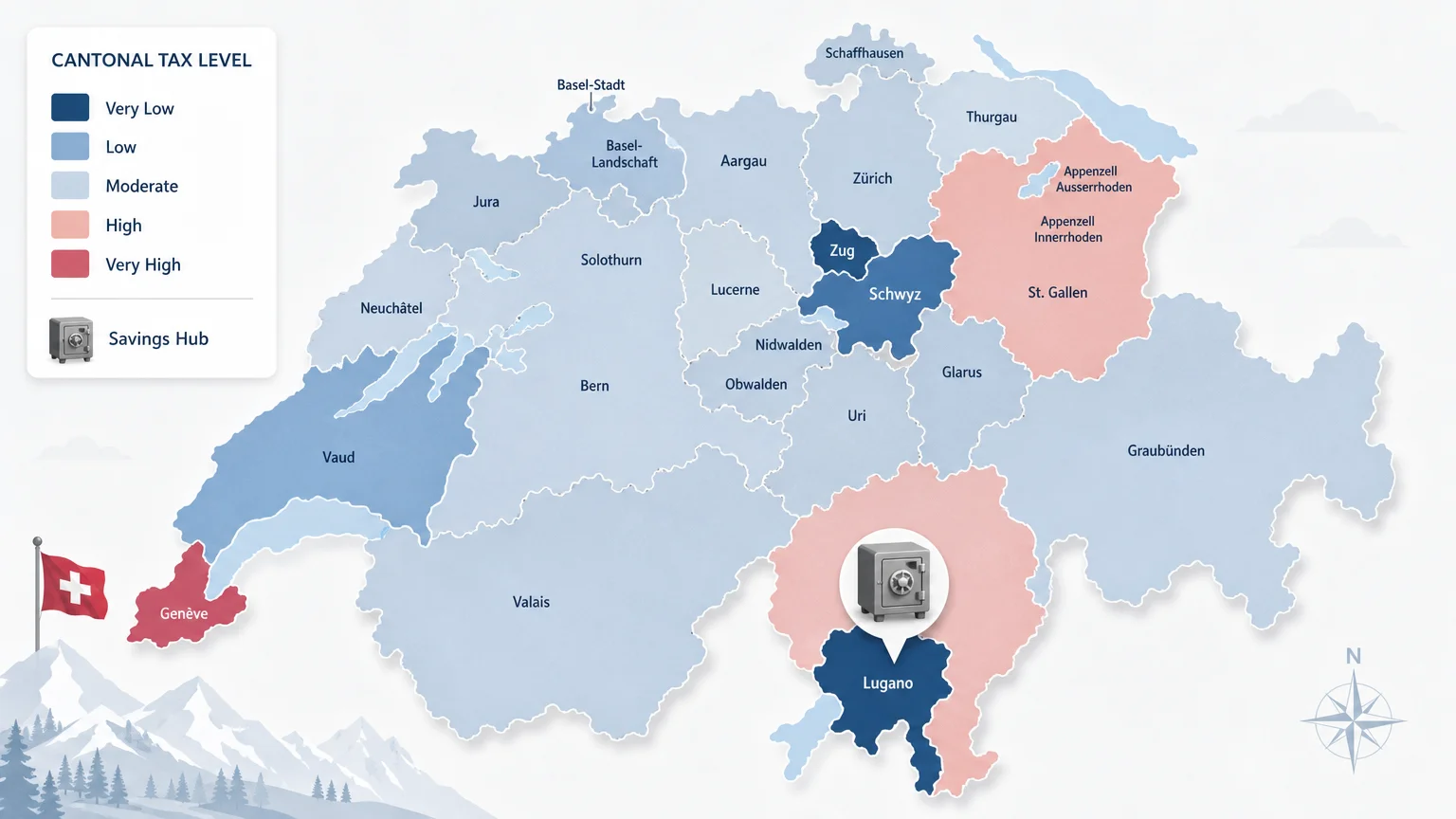
Here is the mechanism that decides thousands of francs. Swiss pension foundations, both 3a foundations and vested benefits foundations, are domiciled in a specific canton. The withholding tax on your lump sum is levied at the rate of that canton, not at the rate of where you last lived. A saver who spent fifteen years in Zurich but whose 3a is held by a foundation registered in a low-tax canton pays the lower rate at exit.
Crucially, 3a balances are portable between qualified Swiss providers, and a transfer between foundations does not trigger tax. That means you can move an account from a high-tax to a low-tax canton of foundation while still resident in Switzerland, right up until you file the withdrawal request. The savings compound with the balance. According to an analysis citing Vermögens-Partner 2026, on a CHF 1,000,000 withdrawal the difference between the cheapest and most expensive approach can exceed CHF 100,000. The canton of Schwyz also revised its tax law in May 2025, a reminder that these tables move.
EU/EFTA versus non-EU/EFTA destinations
Your destination country changes what you may withdraw. If you move to an EU or EFTA country, the mandatory portion of your second pillar cannot be paid out in cash; it must remain in Switzerland in a vested benefits account until retirement age, while the supplementary non-mandatory portion stays withdrawable. If you move outside the EU or EFTA, you can generally take the full second pillar as a lump sum. As a 2026 relocation tax guide summarises, freedom-of-movement rules govern the mandatory portion, and the non-EU route allows a full cash withdrawal subject to Swiss source tax.
There is a nuance worth noting. Even within the EU or EFTA, if you are not subject to compulsory old-age, death, and disability insurance in your new country, you may be able to withdraw the mandatory part in full. This requires confirmation from the LOB Guarantee Fund. Liechtenstein is treated as having equivalent occupational pension rules, so it does not count as a foreign state for full withdrawal in the ordinary sense.
How much tax you actually pay
Lump-sum pension withdrawals are taxed separately from your other income, at a reduced rate. In most cantons this corresponds to about one fifth of the ordinary rate, as a 2026 second-pillar tax overview explains, and persons domiciled abroad are taxed directly at source. The federal portion is uniform; the cantonal portion is where the variation lives. According to a 2026 canton-by-canton comparison, the tax on a CHF 500,000 lump sum ranges from roughly CHF 25,700 to CHF 49,500 depending on canton.
Two further levers reduce the bill. Splitting a large withdrawal across two tax years compresses the progressive tariff. And a voluntary buy-in made less than three years before withdrawal is locked: the amount cannot be paid out as capital during that window, and an early payout can undo the original deduction. The table below compares the common approaches rather than the cantons.
| Approach | Canton lever used | Treaty refund filed | Typical outcome |
|---|---|---|---|
| Default cash-out at your existing foundation | No | Rarely | Highest tax retained by canton |
| Self-managed transfer to a low-tax foundation | Sometimes | Sometimes | Partial saving, timing risk |
| Independent advisory review with us | Yes, assessed early | Yes, where treaty permits | Levers and refunds captured before the window closes |
Timing, treaties, and the documents you will need
Switzerland maintains double-taxation agreements with more than one hundred countries, and these determine whether your new home also taxes the payout. Some treaties leave Switzerland with the sole right to tax the lump sum; others let both states tax with a credit mechanism; and a few, such as the United States treaty, let the destination tax while the Swiss withholding tax is refundable through a form-driven procedure with a limited window. Filing that refund is one of the easiest pieces of money to miss.
On timing, the earlier you begin, the more levers remain open. A useful sequence is to review your canton of foundation around twelve months out, model single-year versus staggered withdrawal around six months out, and make any final 3a contribution before you deregister. To release the funds you will typically need a deregistration certificate from your commune, current proof of residence abroad, and, if you are married, notarised spousal consent. If your move also involves a cantonal relocation beforehand, our overview of insurance when moving cantons (and what changes) is worth reading in parallel.
Planning your Swiss pension exit with confidence
The decisions behind withdrawing your Swiss pension when you leave the country are individual but not exotic: which pillar holds your money, which canton your foundation sits in, whether your destination is inside the EU or EFTA, and whether your treaty allows a refund. None of these levers require aggressive tactics, only sequence and awareness. Started twelve months before departure, every option is open; left to the final weeks, only some remain. Treat the withdrawal as a planned financial event, confirm each figure against current cantonal tables, and the cost of leaving is meaningfully lower than the headline bracket suggests.
Take action with Mathias Sudres
Deciding what to do with your second pillar and Pillar 3a before you emigrate is rarely a one-form task, and small differences in canton, timing, and treaty treatment translate into real money kept or lost. If you have a departure on the horizon, the value of a structured review is highest while every lever is still available.
We are an independent, FINMA-registered pension and insurance advisory serving clients across Switzerland. We compare the whole market with full transparency, explain your options in plain terms, and support you through implementation. To review your vested benefits and third pillar strategy before you leave, arrange a free initial conversation with our independent advisory and plan your exit with clarity.
Frequently Asked Questions
Can I withdraw my Pillar 3a when I leave Switzerland?
Yes. Permanent emigration is one of the legal grounds for early release of Pillar 3a. You will need proof of foreign residence and a deregistration certificate, and the payout is taxed at a lump-sum rate in the canton where the foundation is registered.
Why does the canton of my pension foundation matter so much?
The withdrawal tax is levied by the canton where your 3a or vested benefits foundation is domiciled, not where you last lived. Because rates vary widely between cantons, holding your balance in a low-tax foundation can save a substantial amount at exit.
What happens to my second pillar if I move to an EU or EFTA country?
The mandatory portion generally cannot be paid out in cash and must remain in a Swiss vested benefits account until retirement age. The supplementary non-mandatory portion usually stays withdrawable, and full withdrawal may be possible if you are not covered by compulsory insurance in your new country.
Will my new country also tax the withdrawal?
It depends on the double-taxation agreement between Switzerland and your destination. Some treaties give Switzerland sole taxing rights, others allow both states to tax with a credit, and a few make the Swiss withholding tax refundable. Independent tax advice for your specific case is essential.
How far ahead should I plan before leaving?
Ideally around twelve months. That leaves time to review your canton of foundation, transfer balances if beneficial, model staggered withdrawals, and gather documents. Our team can help you assess your third pillar and vested benefits well before your departure date.