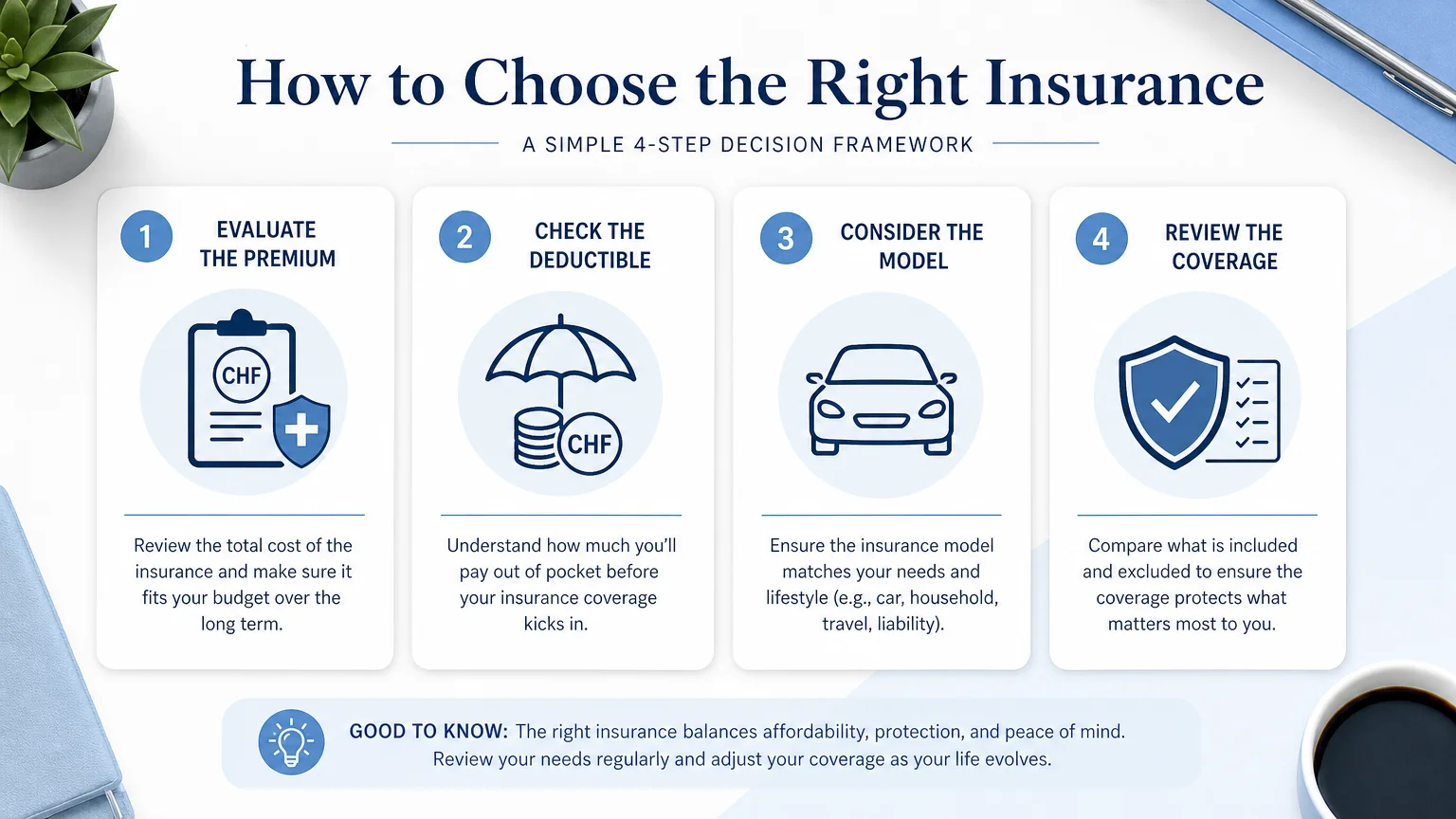
The phrase "best health insurance" hides an uncomfortable truth: every Swiss insurer covers exactly the same basic medical benefits, yet the premium for identical cover can differ by hundreds of francs a month. Knowing the best health insurance for your situation is therefore less about a brand name and more about matching a policy to your canton, your health, and your budget. To weigh one of the biggest levers first, our guide on how to choose your health insurance deductible is a useful starting point.
The stakes rise every year. In 2026, compulsory premiums climbed by an average of 4.4 percent, reaching around 393 francs a month per resident, according to the Federal Office of Public Health. With costs on that trajectory, a methodical comparison is no longer optional.
Why there is no single best health insurer
The most important thing to understand about how to find best health insurance in Switzerland is that the core product is standardised. Basic insurance, governed by the KVG, covers the same doctor visits, hospital stays in your canton, listed prescriptions, and maternity care regardless of which company you choose. An insurer cannot legally reject you for basic cover, and it cannot change what that cover includes.
What genuinely differs is everything around the medicine: the monthly premium, the speed of reimbursement, service quality, English-language support, and how an insurer behaves when you file a claim. A low headline price can mask slow reimbursements or aggressive case management. This is why a ranked list only becomes useful after your personal situation is clear, not before.
Compare premiums before anything else
Because coverage is identical, price is the first practical lever. The spread within a single city is often startling. In Geneva, a 2026 moneyland.ch analysis found the cheapest adult offer at 562 francs a month against 868 francs for the most expensive, a gap of roughly 3,673 francs a year for the very same basic benefits.
That difference is essentially free money left on the table for anyone who never reviews their policy. A structured annual comparison, checking every provider in your canton at your chosen deductible and model, is the single highest-return habit in Swiss health insurance. When you would rather have an independent hand run the numbers across the whole market, we can help you compare Swiss premiums to find the best value for your household.
Choose a deductible that matches your real usage
Swiss basic insurance offers six adult deductible levels, from 300 to 2,500 francs. A higher franchise lowers your premium, but the law caps that discount, so moving from 300 to 2,500 francs saves at most around 1,540 francs a year while exposing you to 2,200 francs more in out-of-pocket risk.
The decision is not emotional; it is arithmetic. There is a break-even point in expected annual medical costs, roughly 2,000 francs in recent Zürich data, below which the high deductible wins and above which the low one does. A healthy young adult who rarely sees a doctor often benefits from the maximum, whereas someone with a chronic condition or a planned pregnancy is usually better served by the minimum. Employer enrolment forms frequently default to the lowest deductible, which can quietly cost a low-usage adult over 1,000 francs a year.
Insurance models that lower your premium
Beyond the deductible, the access model reshapes your bill. The standard model gives free choice of doctor at the highest price. The alternatives trade some flexibility for meaningful savings:
- Family-doctor model (Hausarzt): your GP is the first point of contact and coordinates referrals.
- Telmed model: you call a medical hotline before most in-person visits, which suits digital-first and newly arrived residents.
- HMO model: care runs through an assigned group practice, typically the cheapest option for healthy, low-usage households.
These alternative models can trim monthly costs noticeably, though they come with restrictions on how you enter the system. As with the deductible, employer forms often default to the standard model, so an active choice here is worth real money each month.
Supplementary insurance and pre-existing conditions
Basic cover stops short of semi-private or private hospital rooms, adult dental, many alternative therapies, and elective treatment abroad. This is where supplementary insurance under the VVG matters, and where the rules change entirely. Unlike basic cover, supplementary insurance is medically underwritten, so an insurer can exclude conditions, add surcharges, or decline you outright.
The practical consequence is a golden rule: never cancel an existing supplementary policy until the new insurer has confirmed acceptance in writing. Two plans both labelled "private" can differ sharply in age-based pricing, waiting periods, and exclusions. If your medical past could complicate a switch, review our guidance on what to consider with pre-existing conditions before you move a single contract.
The rising cost backdrop you cannot ignore
Your comparison happens against a steadily more expensive market. The Swiss healthcare market is projected to reach roughly 105.9 billion francs in 2026, and a Deloitte analysis warns that policyholders on the cheapest plans face an average hike near 7 percent, well above the official 4.4 percent headline.
The longer view is even starker. Since the federal health insurance law came into force in 1996, the monthly average has grown from 138 francs in 1997 to 393 francs in 2026, an increase of roughly 184 percent, as reported by Le News. That trend makes an annual review essential rather than a chore, and our Swiss health insurance cost guide (2026) sets out where the pressure is building.
Comparing your routes to the right policy
How you shop matters as much as what you buy. The table below contrasts the common paths, using the criteria that decide value over the long term.
| Route | Market coverage | Independence | Ongoing follow-up |
|---|---|---|---|
| Working with us at Mathias Sudres | Full market comparison across Swiss providers | FINMA-registered, no tied products or hidden commissions | Proactive annual review and long-term availability |
| Price comparison websites | Broad, but self-service | Often commission-funded | None, you monitor changes yourself |
| Direct with one insurer | Limited to that insurer | Sells its own products | Focused on retention |
| Employer default form | Single pre-selected setup | No comparison | None |
An independent, transparent review reads the actual contract wording rather than the brochure, matches the deductible and model to your usage, and revisits the decision every autumn as premiums shift. That combination of breadth, independence, and continuity is what turns a one-off purchase into a durable saving.
Turning comparison into a confident decision
Finding the best health insurance for your circumstances is a process, not a product. Confirm that basic cover is standardised, compare every premium in your canton, then tune the deductible and model to your genuine medical usage rather than a default form. Treat supplementary cover with extra caution, since underwriting can close doors you may want open later. Repeat the exercise each year, because a market that has grown for four consecutive years rewards those who review and quietly penalises those who do not.
Take action with Mathias Sudres
Sorting through eleven insurers, six deductibles, four models, and a maze of supplementary contracts is a great deal to carry alone, especially while premiums keep climbing. This is precisely where independent, personalised guidance pays for itself.
As an independent, FINMA-registered advisor, we compare the entire Swiss market on your behalf, explain each option in plain terms, and stay available for the annual review that keeps your cover efficient. With no tied products and no hidden commissions, our recommendations follow your interests alone. Discover our independent FINMA-registered insurance advisory and start with a free initial conversation about your situation.
Frequently Asked Questions
Is the cheapest health insurance always the best choice?
Not necessarily. Basic benefits are identical everywhere, but the cheapest insurer may be slower to reimburse or more aggressive in case management. Weigh service quality and claims behaviour alongside the premium before deciding.
How often should I compare my health insurance in Switzerland?
Every year, ideally in the autumn before the cancellation deadline. Premiums are reset annually and rose by an average of 4.4 percent in 2026, so a policy that was competitive last year may no longer be. An annual review protects you against silent increases.
Can an insurer refuse to cover me?
For basic insurance, no; acceptance is mandatory for every resident. Supplementary insurance is different, as it is medically underwritten and can be declined, surcharged, or restricted. Never cancel an existing supplementary policy before written acceptance from a new insurer.
What deductible should I choose?
It depends on your expected annual medical costs relative to the break-even point, roughly 2,000 francs. A high deductible suits healthy, low-usage adults, while a low one suits those with regular treatment. Our advisory can calculate your personal break-even against your cash flow.
Do alternative insurance models really save money?
Yes. Family-doctor, Telmed, and HMO models reduce premiums in exchange for how you access care first. The savings can be significant each month, though they involve restrictions such as calling a hotline or using a designated practice.